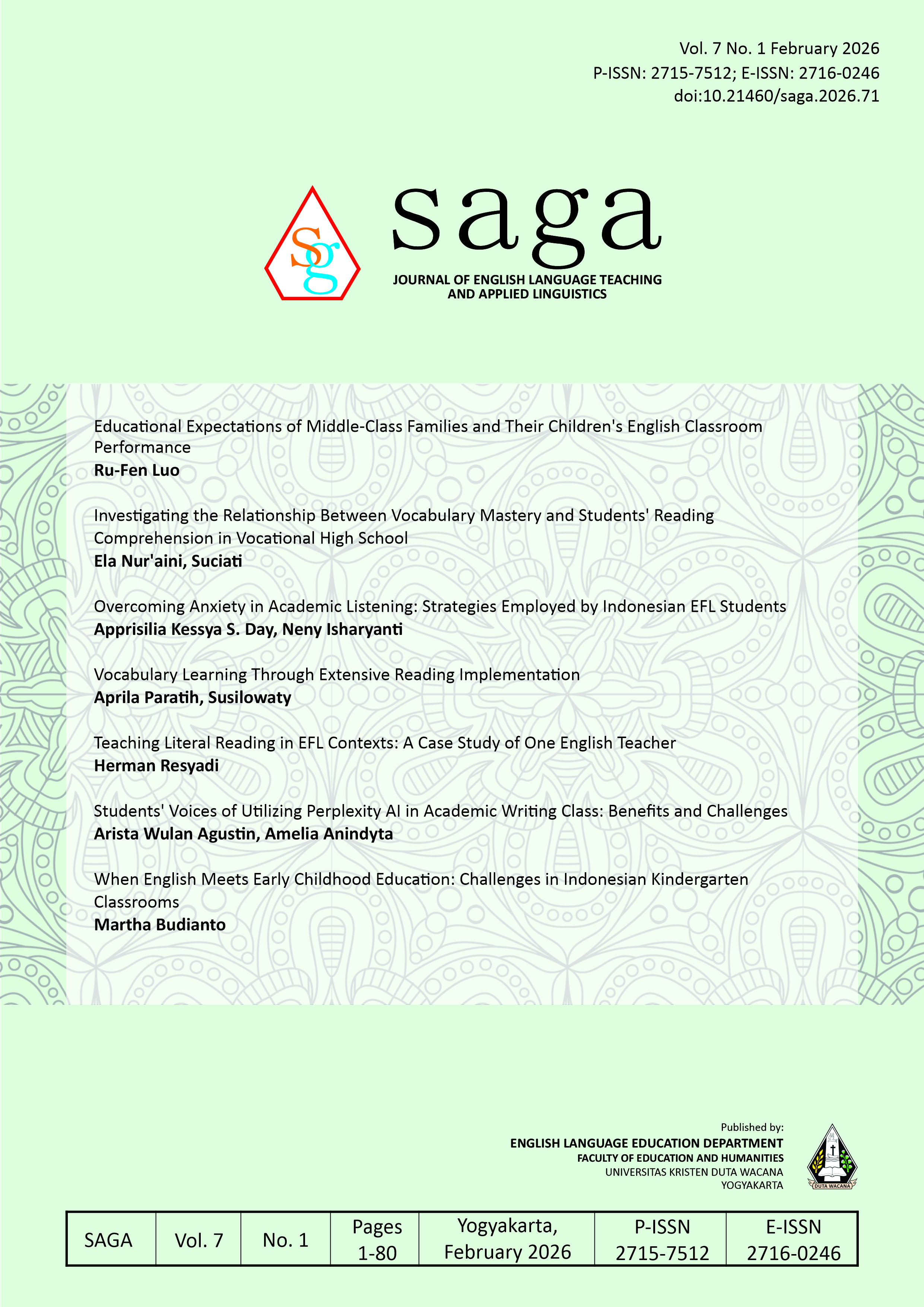
When English Meets Early Childhood Education: Challenges in Indonesian Kindergarten Classrooms
DOI:
https://doi.org/10.21460/saga.2026.71.260Keywords:
Early Childhood Education, English as a Foreign Language (EFL), Indonesia Kindergarten Teachers, Teacher ChallengesAbstract
This study investigates the challenges faced by kindergarten teachers in teaching English as a foreign language (EFL) in Indonesian early childhood education settings. Using a qualitative research design, data were collected through semi-structured interviews and classroom observations involving kindergarten teachers responsible for English instruction. The findings reveal four major challenges: limited professional training in teaching English to young learners, unclear curricular guidance for early English instruction, limited use of English in classroom interaction, and classroom management difficulties. Among these, insufficient teacher training emerged as the most dominant issue, influencing teachers’ pedagogical confidence, instructional strategies, and language use in the classroom. Teachers reported that pre-service and in-service training programs emphasized theoretical knowledge rather than practical approaches suitable for young learners. The absence of clear curricular direction and limited instructional time further contributed to inconsistent teaching practices. Additionally, teachers’ varying levels of English proficiency affected their ability to provide accurate language models, often resulting in heavy reliance on the first language. Classroom management difficulties were also intensified by children’s limited comprehension of English instructions. These findings highlight the need for clearer curricular frameworks, targeted professional development, and improved pedagogical support to enhance the quality of early childhood EFL instruction in Indonesia.
References
Adriany, V. (2022). Early childhood education in Indonesia. In International Handbook on Education in Southeast Asia (pp. 303-326). Springer Nature Singapore. https://doi.org/10.1007/978-981-16-8136-3_28-1
Al-Darwish, S. (2013). Kindergarten children and language learning: Missing pillars for language acquisition. International Journal of Higher Education, 2(1), 44–52. https://doi.org/10.5430/ijhe.v2n1p44
Andriono, M. A., Curtis, C. J., Block, N., & Prasasti, S. (2025). Exploring the effectiveness of mobile learning on early literacy skills of kindergarteners in Indonesia. Journal of Children and Media, 1–21. https://doi.org/10.1080/17482798.2025.2506488
Dali, F. A., Kaharu, A., & Husain, R. (2025). Meta-analysis of challenges and solutions in early childhood education in Indonesia. International Journal of Scientific Research in Science and Technology, 12(1), 81–94. https://doi.org/10.32628/IJSRST25121159
Darcy, I. (2018). Powerful and effective pronunciation instruction: How can we achieve it? The CATESOL Journal, 30(1), 13–45. https://doi.org/10.5070/B5.35963
Daud, A. (2024). English instruction challenges and opportunities in Indonesian primary schools: A systematic review. Journal of English Language Teaching Innovations and Materials, 6(1), 1–18. https://doi.org/10.26418/jeltim.v6i1.72178
Fareh, S. (2010). Challenges of teaching English in the Arab world: Why can’t EFL programs deliver as expected? Procedia – Social and Behavioral Sciences, 2(2), 3600–3604. https://doi.org/10.1016/j.sbspro.2010.03.559
Gilbert, J. (2008). Teaching pronunciation using the prosody pyramid. Cambridge University Press.
Habeeb, K. M. (2013). Teachers’ perceptions toward implementing English as a foreign language at kindergarten: What can we learn from the case of Kuwaiti kindergarten teachers? [Doctoral dissertation, University of Arkansas]. https://scholarworks.uark.edu/etd/836/
Iliasova, L., Nekrasova, I., Mena, J., & Estrada-Molina, O. (2025). Microteaching on preservice teachers’ education: Literature review. Frontiers in Education, 10, Article 1562975. https://doi.org/10.3389/feduc.2025.1562975
Kallio, H., Pietilä, A.-M., Johnson, M., & Kangasniemi, M. (2016). Systematic methodological review: Developing a framework for a qualitative semi-structured interview guide. Journal of Advanced Nursing, 72(12), 2954–2965. https://doi.org/10.1111/jan.13031
Kang, D.-M. (2013). EFL teachers’ language use for classroom discipline: A look at complex interplay of variables. System, 41(1), 149–163. https://doi.org/10.1016/j.system.2013.01.002
Konomi, D. K. (2014). Using visual materials in teaching vocabulary in English as a foreign language. In Proceedings of the International Conference: New Perspectives in Science and Education (pp. 254–259).
Laila, F. N., Adityarini, H., & Maryadi, M. (2023). Challenges and strategies in teaching English speaking skills to young learners: Perspectives of teachers in Indonesia. Voices of English Language Education Society (VELES), 7(3), 542–556. https://doi.org/10.29408/veles.v7i3.24030
Lewis, T. J., Mitchell, B. S., Trussell, R., & Newcomer, L. (2014). School-wide positive behavior support: Building systems to prevent problem behavior and develop and maintain appropriate social behavior. In C. M. Evertson & C. S. Weinstein (Eds.), Handbook of classroom management: Research, practice, and contemporary issues (pp. 40–59). Routledge.
Liando, N. V. F., & Tatipang, D. P. (2022). English or Indonesian language? Parents’ perception toward children’s second language learning context. Jurnal Lingua Idea, 13(1), 61–75. https://doi.org/10.20884/1.jli.2022.13.1.5749
Marashi, H., & Assgar, F. (2019). EFL teachers’ effective classroom management and learners’ anxiety and learning strategies. Iranian Journal of Language Teaching Research, 7(2), 65-82.
Nowell, L. S., Norris, J. M., White, D. E., & Moules, N. J. (2017). Thematic analysis: Striving to meet the trustworthiness criteria. International Journal of Qualitative Methods, 16, 1–13. https://doi.org/10.1177/1609406917733847
Pinter, A. (2017). Teaching young language learners. Oxford University Press.
Shaojie, T., Abd Samad, A. A., & Ismail, L. (2022). Systematic literature review on audio-visual multimodal input in listening comprehension. Frontiers in Psychology, 13, Article 980133. https://doi.org/10.3389/fpsyg.2022.980133
Yasin, M. H. M., Susilawati, S. Y., Tahar, M. M., & Jamaludin, K. A. (2023). An analysis of inclusive education practices in East Java Indonesian preschools. Frontiers in Psychology, 14, Article 1064870. https://doi.org/10.3389/fpsyg.2023.1064870
Zein, M. S. (2017a). Elementary English education in Indonesia: Policy developments, current practices, and future prospects: How has Indonesia coped with the demand for teaching English in schools? English Today, 33(1), 53–59. https://doi.org/10.1017/S0266078416000407
Zein, M. S. (2017b). Professional development needs of primary EFL teachers: Perspectives of teachers and teacher educators. Professional Development in Education, 43(2), 293–313. https://doi.org/10.1080/19415257.2016.1156013