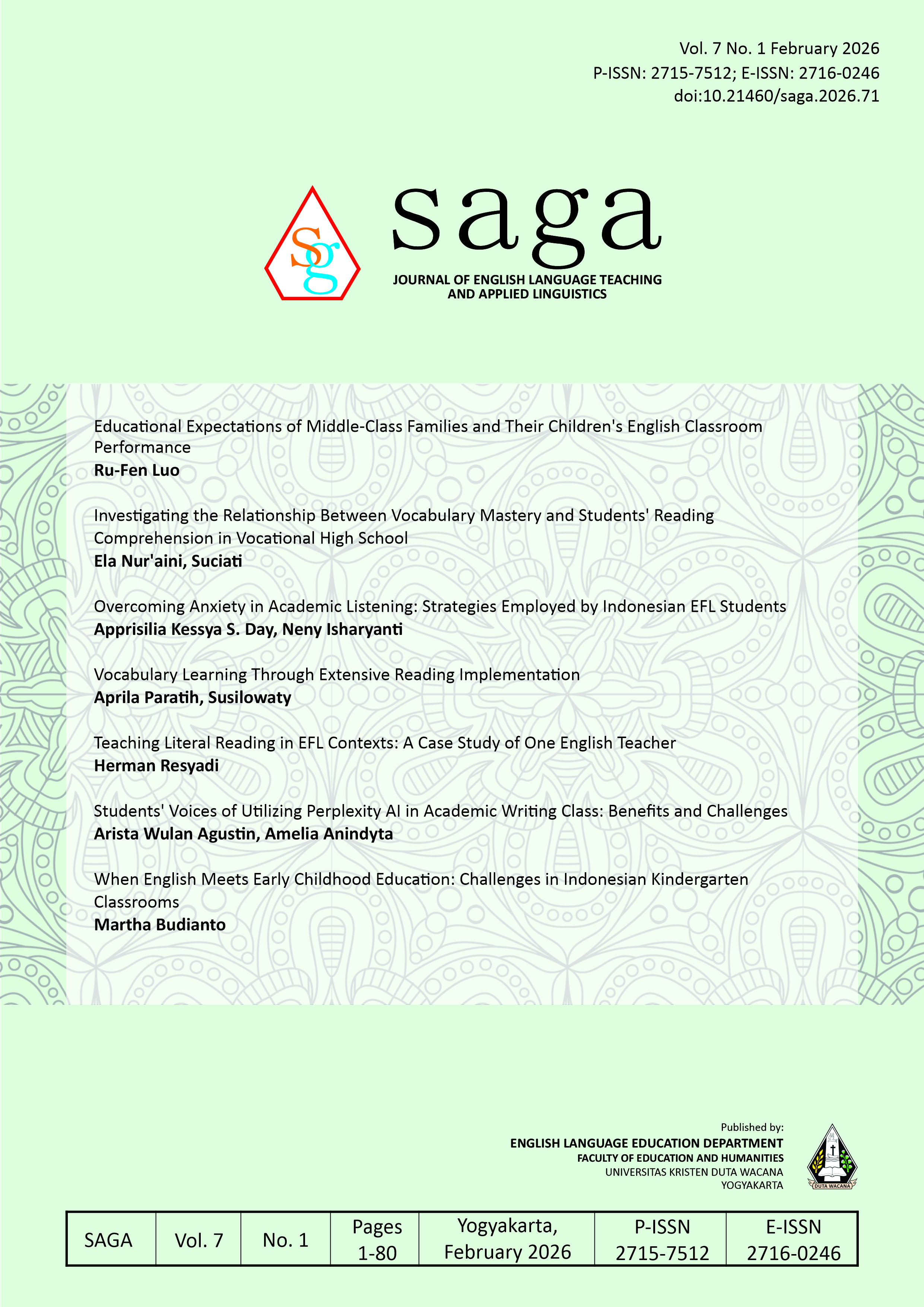
Teaching Literal Reading in EFL Contexts: A Case Study of One English Teacher
DOI:
https://doi.org/10.21460/saga.2026.71.258Keywords:
case study, EFL, literal reading, reading comprehensionAbstract
The main objective of this study is to explore how an English teacher teaches literal reading comprehension in an EFL context. This study employs a qualitative case study design. The semi-structured interview was used as the instrument to explore teachers’ understanding of literal reading, instructional strategies, perceived student difficulties, and contextual factors influencing instruction. Thematic analysis was for the data analysis stage. The study identified four major themes: conceptualizing literal reading as a foundational skill, strategy-oriented instruction, vocabulary-related challenges, and teacher scaffolding within contextual constraints. Therefore, it is concluded that teaching literal reading comprehension is a demanding process and plays a crucial role in supporting students’ reading development in EFL classrooms.
References
Al-Khasawneh, F. (2019). The impact of vocabulary knowledge on the reading comprehension of Saudi EFL learners. Journal of Language and Education, 5(3), 24–34. https://doi.org/10.17323/jle.2019.8822
Alderson, J. C. (2000). Assessing reading. Cambridge University Press.
Alshehri, A. S. (2024). The relationship between reading comprehension and critical thinking among EFL learners. LITERA, 23(3), 309–318. https://doi.org/10.21831/ltr.v23i3.74118
Braun, V., & Clarke, V. (2006). Using thematic analysis in psychology. Qualitative Research in Psychology, 3(2), 77–101. https://doi.org/10.1191/1478088706qp063oa
Burns, P. C., Roe, B. D., & Ross, E. P. (1996). Teaching reading in today’s elementary schools (6th ed.). Houghton Mifflin.
Cahyani, R. Y. D. (2023). The reading skills of EFL university students: Proficiency, challenges, and strategies (Case study at Universitas Al-Ghifari). The Gist: Journal of English Language Teaching, 6(2). 19-26. https://doi.org/10.53675/gist.v6i2.1369
Cain, K., & Oakhill, J. (2007). Children’s comprehension problems in oral and written language. Guilford Press.
Chinpakdee, M., & Gu, P. Y. (2024). The impact of explicit strategy instruction on EFL secondary school learners’ reading. Language Teaching Research, 28(1), 296–319. https://doi.org/10.1177/1362168821994157
Creswell, J. W. (2013). Qualitative inquiry and research design: Choosing among five approaches (3rd ed.). Sage.
Creswell, J. W. (2014). Research design: Qualitative, quantitative, and mixed methods approaches (4th ed.). Sage.
Ferdinandus, M. S., & Simanjuntak, J. (2024). Interplay between reading strategies and comprehension challenges in academic reading: Insights from Indonesian EFL learners. Jurnal Tahuri, 21(1), 1–19. https://doi.org/10.30598/tahurivol21issue1page1-19
Grabe, W. (2009). Reading in a second language: Moving from theory to practice. Cambridge University Press.
Grabe, W., & Stoller, F. L. (2011). Teaching and researching reading (2nd ed.). Pearson Education.
Kandisa, J. (2025). The relationship between vocabulary and reading comprehension of senior high school students. Journal of English Language and Education, 10(5), 477–495. https://doi.org/10.31004/jele.v10i5.1402
Kasim, U., & Raisha, S. (2025). EFL students’ reading comprehension problems: Linguistic and non-linguistic complexities. English Education Journal. https://jurnal.usk.ac.id/EEJ/article/view/8920?utm_source=chatgpt.com
Kintsch, W. (1998). Comprehension: A paradigm for cognition. Cambridge University Press.
Limeranto, J. T., & Subekti, A. S. (2021). Indonesian theology students’ foreign language reading anxiety and reading performance: a correlational study. Studies in English Language and Education, 8(1), 131–142. https://doi.org/10.24815/siele.v8i1.17398
Lincoln, Y. S., & Guba, E. G. (1985). Naturalistic inquiry. Sage.
Malau, A., Sembiring, Y. B., & Lumbanbatu, I. M. F. (2025). Teacher’s strategies in teaching reading comprehension: A qualitative case study at a junior high school. Teaching English and Language Learning Journal, 5(2), 141–158. https://doi.org/10.36085/telle.v5i2.8326
Manihuruk, D. H. (2020). The correlation between EFL students’ vocabulary knowledge and their reading comprehension: A case study at the English education department of Universitas Kristen Indonesia. Journal of English Teaching, 6(1), 86–95. https://doi.org/10.33541/jet.v6i1.1264
Merriam, S. B. (2009). Qualitative research: A guide to design and implementation. Jossey-Bass.
Miles, M. B., Huberman, A. M., & Saldaña, J. (2014). Qualitative data analysis: A methods sourcebook (3rd ed.). Sage.
Nation, I. S. P. (2009). Teaching ESL/EFL reading and writing. Routledge.
Patton, M. Q. (2015). Qualitative research & evaluation methods (4th ed.). Sage.
Purnamasari, L., & Trisno, E. (2022). An analysis of students’ ability in reading comprehension by using Barrett’s taxonomy. Journal of English Language Teaching, 11(2), 1–12. https://doi.org/10.24036/jelt.v11i2.116865
Sinuhaji, L. E. B., Sibarani, B., & Siregar, T. M. (2024). Reading comprehension of texts with different lexical densities and topic familiarity among Grade 10 students. Genre Journal: Journal of Applied Linguistics, 13(2). https://doi.org/10.24114/gj.v13i2.65438
Sukida, S., Sulfasyah, & Tarman. (2025). Revitalizing local wisdom through fictional texts: Enhancing reading comprehension in Indonesian primary classrooms. Jurnal Ilmiah Iqra, 19(2), 279–290. http://dx.doi.org/10.30984/jii.v19i2.3760
Susana, S. A., & Rojabi, A. R. (2025). Enhancing EFL students’ reading proficiency and engagement through the KWL strategy in descriptive texts. Journal of English in Academic and Professional Communication, 11(1), 37–54. https://doi.org/10.25047/jeapco.v11i1.5737
Susanti, Y. P., & Subekti, A. S. (2020). Jigsaw strategy for cooperative learning in an English reading class: Teacher’s and students’ beliefs. Pedagogy: Journal of English Language Teaching, 8(2), 102–114. https://doi.org/10.32332/pedagogy.v8i2.2274
Zhang, L. J., & Wu, A. (2009). Chinese senior high school EFL students’ metacognitive awareness and reading-strategy use. Reading in a Foreign Language, 21(1), 37–59. https://doi.org/10.64152/10125/66635