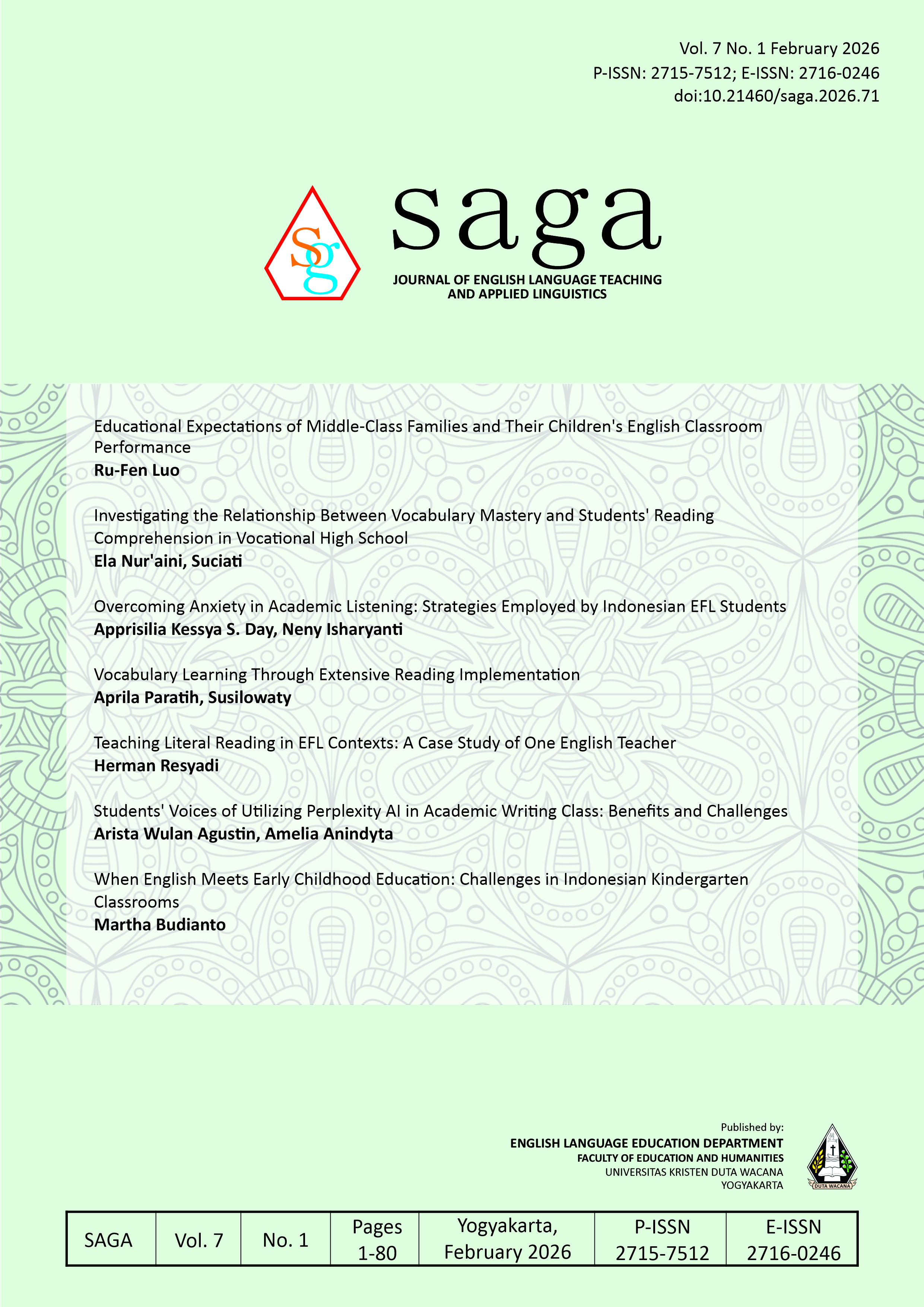
Educational Expectations of Middle-Class Families and Their Children’s English Classroom Performance
DOI:
https://doi.org/10.21460/saga.2026.71.256Keywords:
middle-class, educational expectations, cultural capital, concerted cultivationAbstract
This study investigates the educational expectations of a middle-class family in Taiwan and how they align with their child’s English classroom performance. Using a qualitative case study approach, the researcher conducted English classroom observations and parents’ interviews over a two-year period, focusing on a primary school student’s English learning. The findings reveal a multifaceted educational approach that goes beyond mere academic achievement. Parents in this study actively invest in creating a structured, immersive language environment at home, demonstrating a clear transmission of cultural capital that aligns with Bourdieu’s concept of habitus and Lareau’s strategy of concerted cultivation. Their expectations for their child’s learning transcend basic skills, emphasizing the pursuit of higher-order thinking, creativity, and thoughtful expression. Additionally, they place significant value on the child’s learning attitude and character, focusing on behaviors like diligence and respect. While the student’s performance largely reflected these high expectations—showing active participation and strong language skills—there were occasional gaps in meeting the parents’ demand for “perfection” and “deep thinking.” This highlights the complex interplay between parental expectations, individual student traits, and environmental factors. The study concludes that middle-class educational strategies not only reproduce cultural capital but also cultivate specific learning behaviors and attitudes, offering valuable insights into the social reproduction of educational advantages in a Taiwanese context.
References
Ball, S. J. (2003). Class strategies and the education market: The middle-classes and social advantage. Routledge.
Ball, S. J. (2005). Education policy and social class: The selected works of Stephen J. Ball. Routledge.
Ball, S. J., Bowe, R., & Gewirtz, S. (1996). School choice, social class and distinction: the realization of social advantage in education. Journal of education policy, 11(1), 89-112. https://doi.org/10.1080/0268093960110105
Bourdieu, P. (1986). The forms of capital. In J. Richardson (Ed.), Handbook of theory and research for the sociology of education (pp. 241–258). Greenwood.
Chang, F. C. (2006). Structural equation model testing of the effects of socioeconomic status, cultural capital, and educational expectations on academic achievement. Journal of Psychological and Educational Testing, 53(2), 261-295. https://doi.org/10.7108/PT.200612.0261
Chang, F. C. (2021). The influence of family background, family learning resources, learning motivation, educational expectations, and natural science achievement on mathematics achievement in junior high school students. Journal of University of Taipei (Educational Sciences), 52(2), 1-30. https://doi.org/10.6336/JUTEE.202112_52(2).0001
Chang, F. C., & Lin, Y. C. (2018). A study on the influence of parental education level, cultural capital, educational expectations, and learning beliefs on Chinese language achievement. Journal of University of Taipei, 49(1), 1-26. https://doi.org/10.6336/JUTEE.201806_49(1).0001
Chou, H. F. (2008). The impact of social class on children’s academic achievement: An analysis based on the framework of family resources. Taiwanese Journal of Educational Sociology, 8(1), 1-43. https://doi.org/10.3966/102887082017126304002
Jheng Y.-J. (2017). Learning to Labor or Being Afraid to Labor? An Analysis of the High-Academic-Achievement Working-Class Students and Parents’ Counter-Reproduction Attitude in the Taiwanese Society. Bulletin of Educational Research, 63(4), 65-100. https://doi.org/10.3966/102887082017126304003
Khan, S. R. (2019). Privilege: The making of an adolescent elite at St. Paul’s School. Princeton University Press.
Lareau, A. (1987). Social class differences in family-school relationships: The importance of cultural capital. Sociology of education, 73-85. https://www.jstor.org/stable/2112583
Lareau, A. (2011). Unequal childhoods: Class, race, and family life (2nd ed.). University of California Press.
National Development Council. (2022). A study on the income trend of Taiwan’s middle-class (H. M. Lien, Project Leader).
OECD. (2018). The future of education and skills: Education 2030. OECD Publishing.
Seligman, M. E. P. (2019). Positive education: Educating for prosocial behavior and well-being. Oxford University Press.
Vygotsky, L. S. (1962). Language and thought (pp. 11193-000). MIT Press.
Yang, C. L. (2009). Social class matters greatly: A review of A. Lareau’s unequal childhoods: Class, race, and family Life. Contemporary Educational Research Quarterly, 17(3), 149-157. https://toaj.stpi.niar.org.tw/index/journal/volume/article/4b1141f996444c15019661a6d4d10719
Yang, H. C. (2008). A study on the impact model of parental achievement beliefs and parenting behaviors on children’s academic performance. Journal of Humanities and Social Sciences, 2(2), 149-190. https://doi.org/10.30165/JHSS.200806.0007