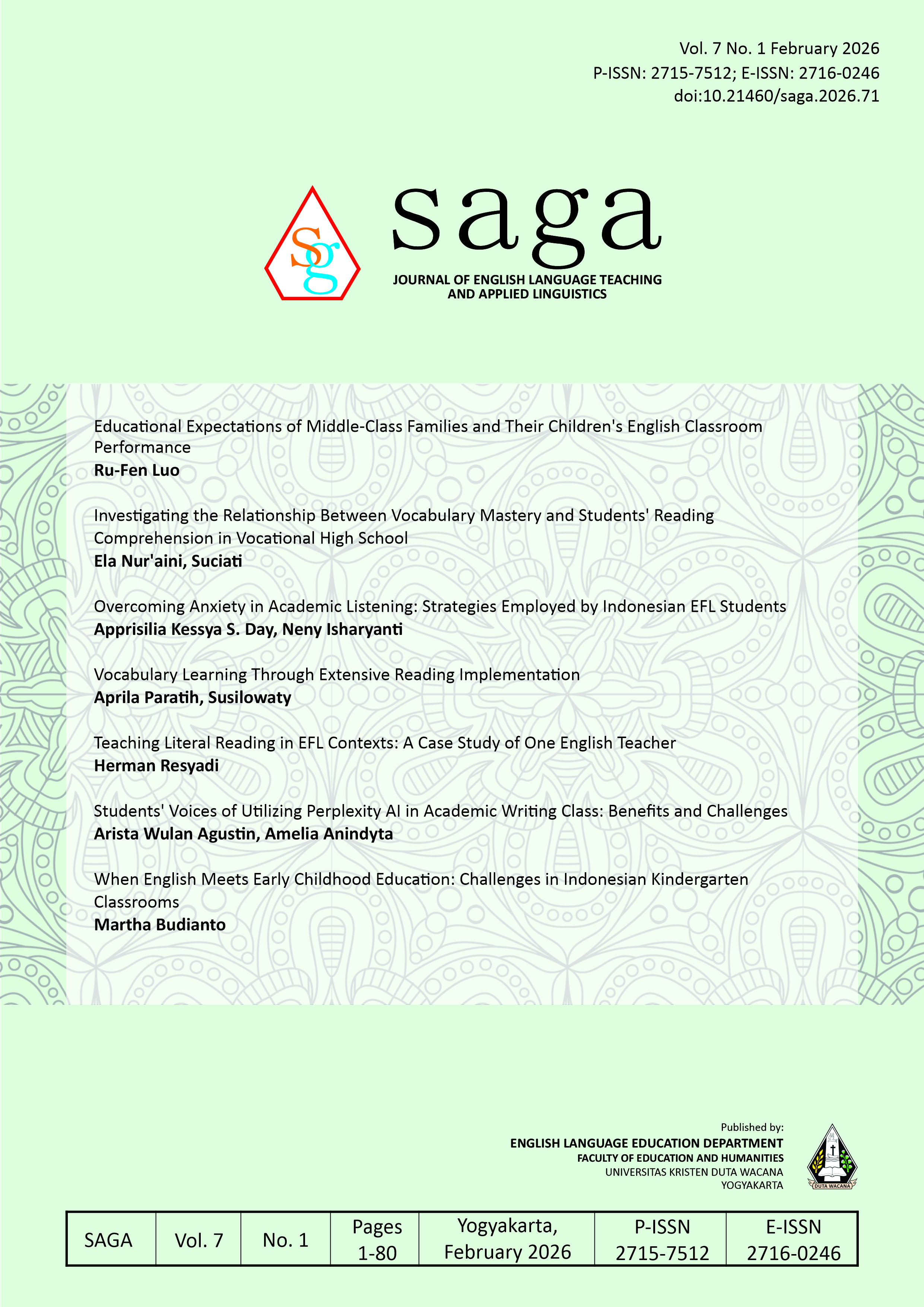
Overcoming Anxiety in Academic Listening: Strategies Employed by Indonesian EFL Students
DOI:
https://doi.org/10.21460/saga.2026.71.244Keywords:
Listening Anxiety, Academic Listening, Anxiety Coping Strategies, EFL studentsAbstract
This study investigates how EFL (English as a Foreign Language) students cope with anxiety during academic listening tasks. Listening anxiety is a common issue among EFL students that may negatively impact on their understanding and performance, especially in academic settings. Using a qualitative research approach, data was gathered through semi-structured interviews with students who had completed academic listening courses at a private university in Central Java. Thematic analysis revealed the occurrence of four main themes: levels of listening anxiety (high, moderate, mild), the role of lecturers (strict or supportive), and coping strategies (cognitive, metacognitive, socio-affective, and spiritual). Students reported experiencing test-related anxiety, misinterpreting audio, and losing focus. To cope, they employed strategies such as prior preparation, mindset shifts, peer support, and prayer. The study highlights the need for both emotional and instructional support to help lower listening anxiety and provides valuable suggestions for teachers to improve students’ listening skills and emotional well-being in EFL classrooms.
References
Abdellatif, M. S., Alshehri, M. A., Alshehri, H. A., Hafez, W. E., Gafar, M. G., & Lamouchi, A. (2024). I am all ears: Listening exams with AI and its traces on foreign language learners' mindsets, self-competence, resilience, and listening improvement. Language Testing in Asia, 14(1), 54. https://doi.org/10.1186/s40468-024-00329-6
Adnan, A., Marlina, L., & Shawfani, A. (2020). Listening anxiety experienced by advanced listening class students of English department UNP Padang. Proceedings of the 3rd International Conference on Education and Science (ICoES 2019). https://doi.org/10.2991/assehr.k.200306.035
Al-Khresheh, M. H. (2020). The impact of cultural background on listening comprehension of Saudi EFL students. Arab World English Journal (AWEJ), 11(3), 349- 371. https://doi.org/10.24093/awej/vol11no3.22
Atasheneh, N., & Izadi, A. (2012). The role of teachers in reducing/increasing listening comprehension test anxiety: A case of Iranian EFL learners. English Language Teaching, 5(3), 178-187. https://doi.org/10.5539/elt.v5n3p178
Bao, D., & Guan, C. (2019). Listening strategies. ResearchGate. https://doi.org/10.1002/9781118784235.eelt0588
Cambridge University Press. (2018). Anxiety. In Cambridge Dictionary. Retrieved from https://dictionary.cambridge.org/dictionary/english/anxiety
Constantinou, C. S., Georgiou, M., & Perdikogianni, M. (2017). A comparative method for themes saturation (comets) in qualitative interviews. Qualitative research, 17(5), 571-588. https://doi.org/10.1177/1468794116686650
Chriswiyati, E. P., & Subekti, A. S. (2022). Indonesian L2 learners' listening anxiety and socio-affective listening strategy: A survey study. Englisia: Journal of Language, Education, and Humanities, 9(2), 32-45. https://doi.org/10.22373/ej.v9i2.10708
Chriswiyati, E. P., & Subekti, A. S. (2022). Indonesian L2 learners’ listening anxiety and socio-affective listening strategy: A survey study. Englisia: Journal of Language, Education, and Humanities, 9(2), 32–45. https://doi.org/10.22373/ej.v9i2.10708
Dewaele, J.-M., & MacIntyre, P. D. (2014). The two faces of anxiety and enjoyment in the foreign language classroom. Studies in Second Language Learning and Teaching, 4(2), 237–274. https://doi.org/10.14746/ssllt.2014.4.2.5
Deregözü, A. (2021). The use of listening comprehension strategies in distance language education. English Language Teaching, 14(10), 62-69. https://doi.org/10.5539/elt.v14n10p62
Dimassi, A. (2016). EFL Listening Comprehension, Cognitive and Metacognitive Strategies, and Working Memory (Doctoral Dissertation). University of the West of England.
Dörnyei, Z. (2005). The psychology of the language learner: Individual differences in second language acquisition. Routledge. https://doi.org/10.4324/9781410613349
Farooqi, M. Q. (2023). Listening comprehension anxiety: Causes and suggestive strategies for solutions. Jurnal Multidisiplin Madani, 3(2), 279-290. https://doi.org/10.55927/mudima.v3i2.2773
Gao, L. X., Jun Zhang, L., & Tesar, M. (2020). Teacher cognition about sources of English as a foreign language (EFL) listening anxiety: A qualitative study. Linguistic & Philosophical Investigations, 19. https://doi.org/10.22381/LPI1920203
Goh, C. C. M. (2018). Metacognition in second language listening. In J. I. Liontas (Ed.), The TESOL encyclopedia of English language teaching (pp. 1-7). Wiley. https://doi.org/10.1002/9781118784235.eelt0572
Gultom, Q. Z., Utari, P., & Rahmawati, W. T. (2023). The importance and difficulties of listening skill: A description. Excellence: Journal of English and English Education, 3(1), 28-31. https://doi.org/10.47662/ejeee.v3i1.584
Guswita, K. A., & Sugirin, S. (2021). Factors affecting listening anxiety of senior high school students in English classroom. JOALL (Journal of Applied Linguistics and Literature), 6(1), 32-45. https://doi.org/10.33369/joall.v6i1.11462
Hadijah, S., & Shalawati. (2018). Listening comprehension strategies applied by English language learners. ELT-Lectura: Jurnal Pendidikan, 5(1), 54. https://doi.org/10.31849/elt-lectura.v5i1.1074
Hamouda, A. (2013). An investigation of listening comprehension problems encountered by Saudi students in the EL listening classroom. International Journal of Academic Research in Progressive Education and Development, 2(2), 113-155.
Handayani, S. A., Noni, N., & Ariyani, A. (2023). Challenges faced by students in learning listening comprehension in SMAN 2 Jeneponto. PERFORMANCE: Journal of English Education and Literature, 2(2), 194-203.
Hidayati, A. N., Dewi, N. S. N., Nurhaedin, E., & Rosmala, D. (2020). Foreign language listening anxiety in an academic listening class. J-SHMIC: Journal of English for Academic, 7(2), 1-9. https://doi.org/10.25299/jshmic.2020.vol7(2).5241
In'nami, Y. (2006). The effects of test anxiety on listening test performance. System, 34(3), 317-340. https://doi.org/10.1016/j.system.2006.04.005
Isharyanti, N. (2021). Teacher employability in Indonesia: Analyzing the discourse of professional identities at multiple levels (Doctoral Dissertation). University Of Manchester).
Kok, I. (2018). Relationship between listening comprehension strategy use and listening comprehension proficiency. International journal of Listening, 32(3), 163-179. https://doi.org/10.1080/10904018.2016.1276457
Latupono, F., & Nikijuluw, R. C. G. V. (2022). The importance of teaching listening strategies in English language context. MATAI: International Journal of Language Education, 3(1), 1-10. https://doi.org/10.30598/matail.v2i2.5935
Li, K., Qin, X., Ji, S., & Zou, L. (2023). The effects of general listening anxiety and listening test anxiety on self-perceived listening performance among Chinese English learners. Psychology Research and Behavior Management, 3541-3560. https://doi.org/10.2147/PRBM.S422030
Liu, M. (2016). Interrelations between foreign language listening anxiety and strategy use and their predicting effects on test performance of high-and low-proficient Chinese university EFL learners. The Asia-Pacific Education
Researcher, 25(4), 647-655. https://doi.org/10.1007/s40299-016-0294-1
Liu, M., & Xu, H. (2021). Testing effects of foreign language listening anxiety on Chinese university students' English listening test performance. Frontiers in Psychology, 12, 701926. https://doi.org/10.3389/fpsyg.2021.701926
Major, R. C., Fitzmaurice, S. M., Bunta, F., & Balasubramanian, C. (2005). Testing the effects of regional, ethnic, and international dialects of English on listening comprehension. Language Learning, 55(1), 37–69. https://doi.org/10.1111/j.0023-8333.2005.00289.x
Mcleod, S. (2024). Thematic Analysis: A step-by-step guide. Simply Psychology.
Melanlioglu, D. (2013). Reliability and validity of the listening anxiety scale for secondary school students. Adiyaman Universitesi Sosyal Bilimler Enstitusu Dergisi Turkcenin Egitimi Ogretimi Ozel Sayisi, 6(11), 851-876.
Nadig, A. (2013). Listening comprehension. In F. R. Volkmar (Ed.), Encyclopedia of Autism Spectrum Disorders (pp. 1747-1750). Springer. https://doi.org/10.1007/978-1-4419-1698-3_349
Namaziandost, E., Sabzevari, A., & Hashemifardnia, A. (2018). The effect of cultural materials on listening comprehension among Iranian upper-intermediate EFL learners: In reference to gender. Cogent Education, 5, 1-27. https://doi.org/10.1080/2331186X.2018.1560601
Namaziandost, E., Behbahani, H. K., & Naserpour, A. (2024). Peer support in language learning: Mitigating anxiety, enhancing achievement, cultivating growth mindsets, and increasing enjoyment. Journal of Applied Learning and Teaching, 7(2), 296-313. https://doi.org/10.37074/jalt.2024.7.2.40
Oteir, I., & Abd Aziz, N. H. (2017). Effects of listening comprehension anxiety from Saudi EFL learners’ perspectives. International Journal of Linguistics, 9(5), 113. https://doi.org/10.5296/ijl.v9i5.11792
Oteir, I. N., & Al-Otaibi, A. N. (2019). Foreign language anxiety: A systematic review. Arab World English Journal, 10(3), 309-317. https://doi.org/10.24093/awej/vol10no3.21
Pan, Y. E. (2016). Analysis of listening anxiety in EFL class. International Journal on Studies in English Language and Literature, 4(6), 12-16. https://doi.org/10.20431/2347-3134.0406002
Purwanto, D., Fadhly, F. Z., & Rahmatunisa, W. (2021). Listening comprehension study: Difficulties and strategies used by college Students. Listening, 4(1).
Rezai, A. (2023). Online peer-dynamic assessment as an approach for promoting listening comprehension and relieving learning anxiety: Evidence from Iranian EFL learners. Computer-Assisted Language Learning Electronic Journal, 24(2), 6-31.
Safa, A.M., & Motaghi, F. (2024). Cognitive vs. metacognitive scaffolding strategies and EFL learners' listening comprehension development. Language Teaching Research, 28(3), 987-1010. https://doi.org/10.1177/13621688211021821
Scovel, T. (1978). The effect of affect on foreign language learning: A review of the anxiety research. Language Learning, 28(1), 129–142. https://doi.org/10.1111/j.1467-1770.1978.tb00309.x
Serraj, S. (2015). Listening anxiety in Iranian EFL learners. International Journal of Scientific and Research Publications, 5(6), 1-8.
Shariyevna, K., & Israilova, A. (2020). The importance of listening in foreign language learning. The American Journal of Social Science and Education Innovations, 2(09), 643-646. https://doi.org/10.37547/tajssei/Volume02Issue09-98
Shu-Yan, W., & Cha, K. W. (2019). Foreign language listening anxiety factors affecting listening performance of Chinese EFL learners. Journal of Asia TEFL, 16(1), 121. https://doi.org/10.18823/asiatefl.2019.16.1.8.121
Tahsildar, M. N., & Yusoff, Z. S. (2014). Investigating l2 students’ listening anxiety: A survey at a Malaysian university. International Journal of Language Education and Applied Linguistics, 1. https://doi.org/10.15282/ijleal.v1.418
Tran, L., Nguyen, T. T. B., & Do, D. T. X. (2025). Exploring EFL listening anxiety and its correlation with learners’ perceived listening proficiency, interest, and practice. Theory & Practice in Language Studies (TPLS), 15(6). https://doi.org/10.17507/tpls.1506.04
Ugwu, C. N., & Eze, V. H. (2023). Qualitative research. IDOSR Journal of Computer and Applied Sciences, 8(1), 20-35.
Vandergrift, L., & Goh, C. (2012). Teaching and learning second language listening: Metacognition in action. New York.
Waloyo, E. (2024). English Foreign Language (EFL) students’ listening strategies and the challenges in the digital era. Foreign Language Instruction Probe, 3(1), 43-53. https://doi.org/10.54213/flip.v3i1.410
Wang, S-Y. & Cha, K-W. (2019). Foreign language listening anxiety factors affecting listening performance of Chinese EFL learners. The Journal of Asia TEFL, 16(1), 121-134. http://dx.doi.org/10.18823/asiatefl.2019.16.1.8.121
Wu, H. (2024). How teacher characteristics shape Chinese undergraduate EFL learners' enjoyment and anxiety. Asia Pacific Journal of Education. 1-14. https://doi.org/10.1080/02188791.2024.2385842
Xu, F. (2011). Anxiety in EFL listening comprehension. Theory & Practice in Language Studies (TPLS), 1(12). https://doi.org/10.4304/tpls.1.12.1709-1717
Xu, J., & Huang, Y. T. (2018). The mediating effect of listening metacognitive awareness between listening test anxiety and listening test performance. The Asia-Pacific Education Researcher, 27(4), 313-324. https://doi.org/10.1007/s40299-018-0388-z
Yayli, D. (2017). Using group work as a remedy for EFL teacher candidates’ listening anxiety. Eurasian Journal of Educational Research, 17(71), 41-58.
Zanjani, S. B. A., Tasnimi, M., & Azad, M. (2024). Developing and validating a listening mindset questionnaire through Think-Aloud Protocol. Iranian Journal of Neurodevelopmental Disorders, 3(3), 94-107. https://doi.org/10.61838/kman.jndd.3.3.11